MOTS-c (mitochondrial peptide): what it is, how it is supplied, and how to choose a research supplier
MOTS-c is a 16-amino-acid peptide encoded in the mitochondrial genome (within the 12S rRNA region), about 2,174 Da, supplied as a white lyophilized powder in sealed glass vials of 20, 40 or 60 mg for laboratory research. Research-grade MOTS-c is bought from a supplier that publishes a batch-specific certificate of analysis (HPLC purity and mass confirmation) from an independent laboratory, ships domestically, and sells it strictly as a reagent.
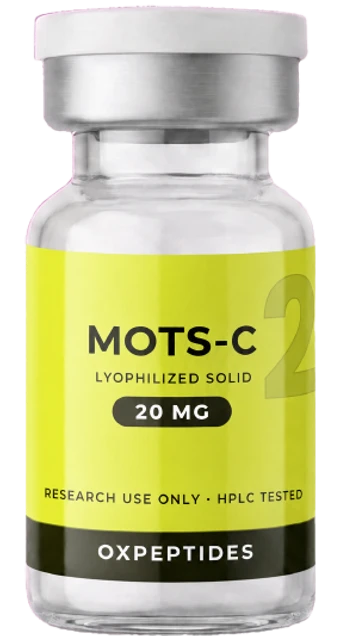
In the catalog
MOTS-cpurity >99% by HPLC — measured value on each lot's COA
| Size | Price | Per unit |
|---|---|---|
| 20 mg | $130 | $6.50 / mg |
| 40 mg | $208 | $5.20 / mg |
| 60 mg | $296 | $4.93 / mg |
Research use only. Not for human or veterinary use. One email when the first batch is listed. No newsletter.
What MOTS-c is
MOTS-c (mitochondrial open reading frame of the 12S rRNA type-c) is a peptide of sixteen amino acids whose coding sequence sits inside the mitochondrial genome, not the nuclear one — a small open reading frame within the 12S ribosomal RNA gene. It was first described in 2015 by the group of Changhan Lee and Pinchas Cohen. The research material is made by chemical synthesis and has a molecular weight of about 2,174 Da.
Three details identify the reagent on a bench:
- The sequence. Sixteen residues, starting with methionine, as published in the 2015 paper. A supplier that cannot state it is selling a name, not a compound.
- The mass. Mass spectrometry on the COA confirms a peak at the expected molecular weight.
- The powder. White, lyophilized, supplied as the acetate salt; hygroscopic like most synthetic peptides.
It belongs to a small family of "mitochondrial-derived peptides" (humanin and the SHLP series are the others). Only MOTS-c is common in research catalogues. In the catalog, MOTS-c is a research reagent: a sealed vial of lyophilized powder with a lot number and a certificate of analysis. Research use only. Not for human or veterinary use.
"MOTS-c" on Google vs MOTS-c as a reagent
The first page for "MOTS-c" is mostly academic: PubMed Central, Nature, a sports-agency notice, a Wikipedia entry. That is where the literature lives. None of those pages describes the object a laboratory receives, and the handful of commercial listings that do appear rarely give the properties that can be checked.
| What to check | Reseller listing | Research reagent |
|---|---|---|
| Identity | "MOTS-c" with no sequence stated | 16-residue sequence, mass confirmed on the COA |
| Quantity | Vague or "per kit" | Net mg on the label (20, 40, 60 mg) |
| Purity documentation | "99 %" as text | HPLC chromatogram with a measured percentage |
| Lot traceability | None | Lot number on the vial, same lot on the COA |
| Container | Unmarked vial | Sealed glass vial, septum, crimp cap, printed label |
| Storage on arrival | Not stated | Freezer, protected from light and moisture |
A listing with no sequence, no mg quantity and no verifiable COA is a reseller — not a research supply.
How MOTS-c is supplied: sizes and what is in the vial
Research MOTS-c comes as a white lyophilized (freeze-dried) powder in a glass vial closed with a rubber septum and an aluminum crimp cap. The label states the compound, the net quantity in milligrams, the lot number and the words "research use only".
The catalog offers three sizes — 20 mg, 40 mg and 60 mg — larger than the 10 mg entry size of shorter peptides, because a 16-residue peptide is typically ordered in larger quantities. The price per milligram is listed for each size. The live table at the top of this page is read directly from the catalog, so the prices shown there are the prices in force today. See MOTS-c in the catalog for availability.
What "20 mg" means on the label
The number is the net mass of MOTS-c powder filled into the vial, and it is the quantity the certificate of analysis refers to. Twenty milligrams of lyophilized peptide is a small white cake at the bottom of a 3 mL vial; the vial is over-sized on purpose.
Purity and peptide content
The powder is an acetate salt with some bound water, so the mass of pure peptide is lower than the mass of powder. A careful COA reports HPLC purity (how clean the peptide is) and, when tested, peptide content (how much of the powder is peptide). For a 16-residue synthesis the HPLC trace should show one dominant peak; a cluster of nearby peaks points to deletion sequences. See HPLC purity: what "> 99 %" means.
What the certificate of analysis must show
For MOTS-c a usable certificate carries:
- The laboratory's name and a verifiable identifier. Independent labs (Janoshik is the reference for this market) give each test a number that anyone can look up on the lab's site. A PDF that cannot be looked up is not a certificate.
- The lot number — identical to the lot number printed on the vial you receive.
- HPLC purity as a measured percentage with the chromatogram. Text that says "≥ 98 %" without a trace is a claim, not a measurement.
- Mass confirmation by mass spectrometry at about 2,174 Da.
- The date of the test. A certificate several months old describes a lot that has probably sold through.
- A photograph of the tested vial wearing the supplier's own label. A COA showing a bare vial was issued to the manufacturer and says nothing about what this supplier bottled.
The full checklist, with examples of what a doctored certificate looks like, is in how to read a peptide COA.
Storage of the sealed vial
MOTS-c is stable as a lyophilized powder when it is kept cold, dark and dry. The catalog's storage line for the sealed vial:
- Temperature: −20 °C for long-term storage; a refrigerator (2–8 °C) is acceptable for short periods.
- Light: keep the vial in its box or in an opaque container.
- Moisture: the powder is hygroscopic. Let a cold vial reach room temperature before removing it from its bag, so no condensation forms on the glass.
- Shelf life: 18 months from the fill date for a sealed vial stored as above — shorter than the 24 months of small peptides such as BPC-157 or GHK-Cu, which is why the fill date on the label matters here.
Shipping at ambient temperature for a few days does not degrade the sealed powder; that is why research peptides ship without cold packs. The general rules, size by size, are in lyophilized peptides: storage and shelf life.
How to choose a MOTS-c supplier in the United States
"Buy MOTS-c" returns few suppliers and many resellers, because the peptide is longer and more expensive to synthesize than most catalog items — a strong incentive to relabel. To sort them, ask six questions of the product page — not of the marketing.
- Is there a batch COA from a named independent lab, and can it be verified on the lab's site? No verifiable COA = no purchase.
- Does the COA show the supplier's own label? A manufacturer's certificate, re-used by a reseller, does not cover what was re-bottled or re-labeled.
- Does the mass spectrum match the 16-residue peptide? For an expensive compound, identity is the first thing a reseller economizes on.
- Does the supplier ship domestically, from US stock, in a few days? Long international transit is where vials get lost, heated or seized.
- Does the page describe the product only — composition, purity, storage — with "research use only" stated plainly? A supplier that publishes usage content is a supplier that is easy to shut down; that risk transfers to the buyer whose order is in transit.
- Is the price at or above the market, not far below it? Third-party testing costs several hundred dollars per lot. A price far under the market is a price that did not pay for testing.
The wider checklist — payment, packaging, what to do if a parcel is stopped — is in where to buy research peptides in the US.
MOTS-c and NAD+
The two are often listed side by side under "mitochondrial". They are different objects: NAD+ is a coenzyme, not a peptide, sold in 500 mg and 1 g sizes. Its own guide is the NAD+ buying guide.
Price: what the catalog offers
The price of research MOTS-c depends on three things: the size of the vial, whether a third-party test was paid for the lot, and where it ships from. A 16-residue synthesis costs more per milligram than a tripeptide, and the entry size is 20 mg rather than 10 mg, so the per-vial price is among the highest in the catalog. The table at the top of this page shows the current price per vial and per milligram for each size.
What the price includes at OXpeptides: a sealed, labeled vial from a tested lot, the batch COA, tracked domestic shipping, and a replacement if a parcel arrives damaged. What it never includes: anything other than the reagent itself.
Published research
The publications a researcher will find when looking this compound up, with their DOI. They characterize the molecule and the models it was studied in; they are listed as references, not as claims about this product.
Lee C, et al. (2015). Cell Metabolism, 21(3), 443-454.
doi:10.1016/j.cmet.2015.02.009
The paper that first described the peptide: the open reading frame in the mitochondrial 12S rRNA gene, the 16-residue sequence, and its detection in cell lines and tissue extracts.
Kim KH, et al. (2018). Cell Metabolism, 28(3), 516-524.
doi:10.1016/j.cmet.2018.06.008
The same group, three years later: where the peptide is found inside cultured cells and which gene-expression changes are measured in those cell models.
FAQ
Where can I buy MOTS-c for research?
What does research-grade MOTS-c cost?
What is MOTS-c, chemically?
How is MOTS-c stored before opening?
Why does MOTS-c start at 20 mg when other peptides start at 10 mg?
Related guides
NAD+ — buying guide
A coenzyme, not a peptide: structure, mass, the white powder, vial sizes, what a batch COA must show.
Read Quality & storageHow to read a peptide COA
What each field must say, how to verify it on the laboratory site, the signs of an edited certificate.
Read Quality & storageLyophilized peptides: storage and shelf life
What lyophilization is, the four things that degrade a peptide, storage temperature and shelf life.
ReadNext step
MOTS-c in the OXpeptides catalog
The first batch is in preparation. One email when it is listed — sizes, price per vial and the batch COA are on the product page.
Research use only. Not for human or veterinary use.