Semax: what it is, how it is supplied, and how to choose a research supplier
Semax is a synthetic heptapeptide, Met-Glu-His-Phe-Pro-Gly-Pro (MEHFPGP), an analog of the ACTH(4-10) fragment with a Pro-Gly-Pro extension, supplied as a white lyophilized powder in sealed 5 mg and 10 mg glass vials for laboratory research. Research-grade Semax is bought from a supplier that publishes a batch-specific certificate of analysis (HPLC purity and mass confirmation) from an independent laboratory, ships domestically, and sells it as a reagent and nothing else.
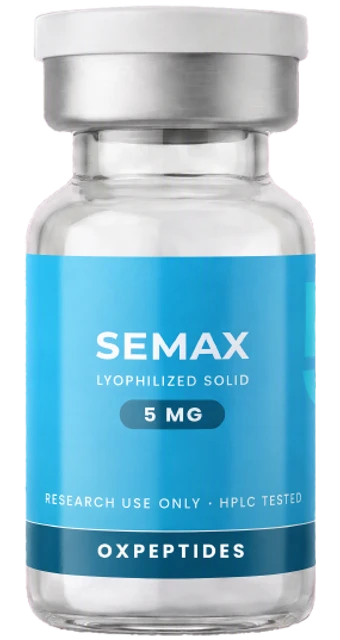
In the catalog
Semaxpurity >99% by HPLC — measured value on each lot's COA
| Size | Price | Per unit |
|---|---|---|
| 5 mg | $35 | $7 / mg |
| 10 mg | $55 | $5.50 / mg |
Research use only. Not for human or veterinary use. One email when the first batch is listed. No newsletter.
What Semax is
Semax is a synthetic peptide of seven amino acids: methionine, glutamic acid, histidine, phenylalanine, proline, glycine, proline — written Met-Glu-His-Phe-Pro-Gly-Pro or MEHFPGP. The first four residues are the fragment 4–7 of adrenocorticotropic hormone (the piece known as ACTH(4-10) once the natural continuation is dropped); the C-terminal Pro-Gly-Pro was added to make the chain more resistant to enzymatic cleavage. Its molecular weight is about 813 Da.
It was designed at the Institute of Molecular Genetics of the Russian Academy of Sciences, the same laboratory that designed Selank. The two share the Pro-Gly-Pro tail and a similar size, which is why they are often listed together and occasionally mislabelled.
Semax is a white to off-white lyophilized powder with no color and no smell. The methionine in position 1 is the one residue to watch: it can oxidize to methionine sulfoxide over time, which is why the sealed vial is kept cold and dark and why the HPLC chromatogram on the COA matters — the oxidized form shows up as a separate peak.
In the catalog, Semax is sold as a research reagent: a sealed vial of lyophilized powder with a batch number and a certificate of analysis. Research use only. Not for human or veterinary use.
Semax vs Selank: two different objects
Same laboratory, same sizes, same white powder — but two different molecules. A listing that presents them as interchangeable has not read the mass spectrum.
| Semax | Selank | |
|---|---|---|
| Sequence | Met-Glu-His-Phe-Pro-Gly-Pro | Thr-Lys-Pro-Arg-Pro-Gly-Pro |
| Parent fragment | ACTH(4-10) | Tuftsin (TKPR) |
| Molecular weight | ~813 Da | ~751 Da |
| Oxidation-prone residue | Methionine (position 1) | None |
| Catalog sizes | 5 mg, 10 mg | 5 mg, 10 mg |
| Shared feature | C-terminal Pro-Gly-Pro extension | |
A supplier that lists both should show a separate COA for each, with an observed mass that matches the right molecule. One certificate covering "Semax/Selank" covers neither.
How Semax is supplied: sizes and what is in the vial
Research Semax comes as a lyophilized (freeze-dried) powder in a glass vial closed with a rubber septum and an aluminum crimp cap. The label states the compound, the net quantity in milligrams, the lot number and the words "research use only".
The catalog offers two sizes — 5 mg and 10 mg — and the price per milligram is lower on the 10 mg vial. The live table at the top of this page is read directly from the catalog, so the prices shown there are the prices in force today. See Semax in the catalog for availability.
What "5 mg" means on the label
The number is the net mass of Semax powder in the vial, as filled, and it is the quantity the certificate of analysis refers to. Five milligrams of lyophilized peptide is a thin white film, not a visible heap; an almost empty-looking vial is the normal appearance of this size.
Acetate or trifluoroacetate
Synthetic peptides are supplied as a salt. Most research Semax is the acetate; some manufacturers leave the trifluoroacetate (TFA) counter-ion from purification. The COA should state which. Neither changes the sequence, but residual TFA is a purity question, and it is one of the differences between a manufacturer's lot and a re-bottled one.
What the certificate of analysis must show
For Semax, the COA answers two questions at once: is it the right molecule, and has the methionine stayed intact? A usable certificate carries:
- The laboratory's name and a verifiable identifier. Independent labs (Janoshik is the reference for this market) give each test a number that anyone can look up on the lab's site.
- The lot number — the same lot number that is printed on the vial you receive.
- HPLC purity as a measured percentage, with the chromatogram. A second peak just before the main one is where the oxidized (sulfoxide) form appears; a clean single peak is what a fresh lot looks like.
- Mass confirmation by mass spectrometry: an observed mass of about 813 Da. A mass 16 Da higher is the oxidized form; a mass of about 751 Da means the vial holds Selank.
- The date of the test. A certificate older than a few months describes a lot that has probably sold through.
- A photograph of the tested vial wearing the supplier's own label. A manufacturer's certificate showing a bare vial says nothing about what this supplier bottled.
What the chromatogram and the mass spectrum look like, peak by peak, is in how to read a peptide COA; what a purity figure does and does not mean is in HPLC purity: what "> 99 %" means.
Storage of the sealed vial
Semax is stable as a lyophilized powder when it is kept cold, dark and dry, and the methionine makes the "dark" and "sealed" parts matter more than for most peptides. The catalog's storage line for the sealed vial:
- Temperature: −20 °C for long-term storage; a refrigerator (2–8 °C) is acceptable for short periods.
- Light: keep the vial in its box or in an opaque container.
- Moisture and air: keep the vial sealed. Let a cold vial reach room temperature before removing it from its bag, so no condensation forms on the glass.
- Shelf life: 24 months from the fill date for a sealed vial stored as above.
Shipping at ambient temperature for a few days does not degrade the sealed powder; that is why research peptides ship without cold packs. The general rules, size by size, are in lyophilized peptides: storage and shelf life.
How to choose a Semax supplier in the United States
"Semax for sale" returns marketplaces, resellers and a handful of research suppliers. To sort them, ask six questions of the product page — not of the marketing.
- Is there a batch COA from a named independent lab, and can it be verified on the lab's site? No verifiable COA = no purchase.
- Does the COA show the supplier's own label? A manufacturer's certificate, re-used by a reseller, does not cover what was re-bottled or re-labeled.
- Does the mass spectrum match Semax (about 813 Da), with a single main HPLC peak? An old or badly stored lot shows the oxidized form as a second peak.
- Does the supplier ship domestically, from US stock, in a few days? Long international transit is where vials get lost, heated or seized.
- Does the page describe the product only — composition, purity, storage — with "research use only" stated plainly? A supplier that publishes usage content is a supplier that is easy to shut down; that risk transfers to any order in transit.
- Is the price at or above the market, not far below it? Third-party testing costs several hundred dollars per lot. A price far under the market is a price that did not pay for testing.
The wider checklist — payment, packaging, what to do if a parcel is stopped — is in where to buy research peptides in the US.
Price: what the catalog offers
The price of research Semax depends on the size of the vial, whether a third-party test was paid for the lot, and where it ships from. The catalog table at the top of this page shows the current price per vial and per milligram for each size; the 10 mg vial has the lower cost per milligram.
What the price includes at OXpeptides: a sealed, labeled vial from a tested lot, the batch COA, tracked domestic shipping, and a replacement if a parcel arrives damaged. What it never includes: anything other than the reagent itself.
Published research
The publications a researcher will find when looking this compound up, with their DOI. They characterize the molecule and the models it was studied in; they are listed as references, not as claims about this product.
Dolotov OV, et al. (2006). Neuroscience, 137(2), 549-559.
doi:10.1016/j.neuroscience.2005.09.016
One of the most cited primary papers on the molecule; it states the sequence, its relation to the ACTH(4-10) fragment, and the gene-expression readouts measured in a rodent model.
FAQ
Where can I buy Semax for research?
What does research-grade Semax cost?
What is the difference between Semax and Selank?
Why does the Semax COA matter more than the label?
How is Semax stored before opening?
Related guides
Selank — buying guide
The tuftsin-derived heptapeptide: sequence, mass, 5 and 10 mg vials, what a batch COA must show.
Read Quality & storageHow to read a peptide COA
What each field must say, how to verify it on the laboratory site, the signs of an edited certificate.
Read Quality & storagePurity: what "99 %" HPLC means
What the HPLC measures, why 99 % is not 99 mg in a 100 mg vial, why a percentage needs a chromatogram.
ReadNext step
Semax in the OXpeptides catalog
The first batch is in preparation. One email when it is listed — sizes, price per vial and the batch COA are on the product page.
Research use only. Not for human or veterinary use.